
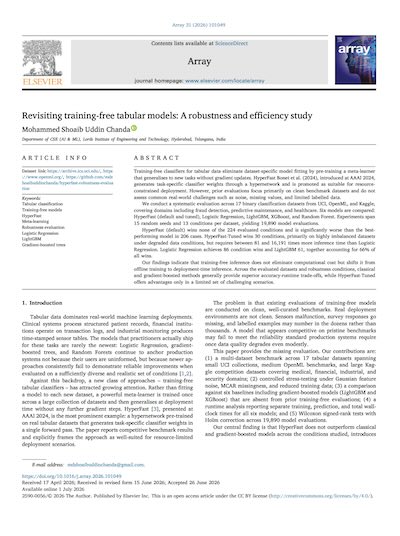
Today's article comes from the Array journal. The authors are Chanda et al., from Lords Institute of Engineering and Technology, in India. In this paper they attempt to rigorously and systematically stress-test the claims behind "HyperFast". Rather than looking only at clean benchmarks, they ask what happens when features become noisy, values go missing, or labeled training data become scarce.
DOI: 10.1016/j.array.2026.101049
In February 2024, at the 38th annual meeting of the AAAI conference in Vancouver, a paper was presented that would send shockwaves through the machine learning community: HyperFast: Instant Classification for Tabular Data. The premise was fairly straightforward: if you're working with tabular data, you don't need to train a new model for every new task. You just need a single general-purpose "meta-learner" that can look at each new task and generate a new special-purpose classifier for that task automatically. You see, HyperFast is what's called a pretrained "hypernetwork". You don't train it. You "meta-train" it, just once. Then, you give it any new labeled tabular dataset and it outputs the weights for a new neural-network classifier that is tailored to that dataset. And that classifier can then make predictions on new rows.
A controversial claim, for sure. But the authors backed it up: they meta-trained HyperFast on a collection of OpenML and genomics tasks, then evaluated it on 15 held-out datasets. They compared its balanced accuracy and total fit-plus-predict time against a host of simple baselines, then gradient-boosted trees, specialized neural tabular models, and AutoML systems across multiple runtime budgets. And in the end, they found that this new system was highly competitive. The same general-purpose network could be applied to many different tabular datasets, and it could generate a new classifier for each one far faster than systems that had to search hyperparameters and fit a fresh model from scratch.
And since that paper's release, the race has been on to either replicate or disprove those authors' results. To figure out if it's really true that a single pretrained hypernetwork can replace conventional dataset-specific training and still generate a competitive classifier for a genuinely unseen task. Or, if the opposite is true. That the authors did some sort of parlor trick: that they cherry-picked or configured favorable datasets, baselines, or runtime budgets to make it seem like the cost and difficulty of fitting a tabular classifier had effectively disappeared.
Today's paper is just such an investigation. An attempt to rigorously and systematically stress-test the robustness and efficiency claims behind HyperFast. Rather than looking only at clean benchmarks, the authors ask what happens when features become noisy, values go missing, or labeled training data become scarce. And, what happens to the performance rankings once deployment-time computation costs are factored in. On today's episode we'll walk through how they performed their analysis, and the results they found. Let's dive in.
Before we figure out whether HyperFast is legit, let's start by walking through how it works.
HyperFast begins by separating out the system that learns how to build classifiers from the classifier that ultimately makes the predictions. During its original meta-training process, a large hypernetwork is exposed to many different classification tasks, each divided into a labeled support set and a separate query set.
The system processes the support features and labels, generates all of the weights for a smaller task-specific neural network, and then passes the query examples through that generated network. The resulting prediction error flows backward through the generated classifier and into the hypernetwork, teaching the hypernetwork which kinds of classifier weights tend to work for datasets with particular statistical characteristics. And repeating that process across many tasks allows it to learn a general mapping from the contents of a labeled dataset to the parameters of a classifier designed for that dataset.
Then, when HyperFast receives a new dataset (a real one that needs a classifier), it first converts its potentially variable collection of columns into a standardized representation. Categorical variables are one-hot encoded, missing values are imputed, and numerical features are standardized. A random feature projection then maps the inputs into a high-dimensional nonlinear representation that approximates a particular kernel. After which principal component analysis compresses that representation into a fixed number of components. This kind of fixed-dimensional representation is important because the original dataset might contain 4 features or 400, but the hypernetwork must still feed information into layers with predetermined dimensions. The transformed support examples, their labels, dataset-wide averages, and class-specific averages are then processed by a sequence of modules. Those modules pool information across the support rows (so that changing the order of the rows does not change the result), then they compress the dataset into task-level embeddings, and use those embeddings to generate the weight matrices and bias vectors for each layer of a smaller multilayer perceptron (MLP). And for its final classification layer, HyperFast pools representations separately by class and supplements them with information from a nearest-neighbor component. Once those parameters have been generated, the smaller network is complete and can classify new rows from the same task.
You will often hear HyperFast referred to as "training-free". But that term requires several qualifications.
What it avoids (and is actually "free" of), in its default configuration, is performing gradient-based optimization on the target dataset after deployment. And despite all this, it can still (ostensibly) perform classification that competes with other state of the art models.
The question is: if you wanted to validate those kinds of claims, how would you go about it? Would you: use HyperFast to generate a classifier, then compare that classifier against existing models? Or would you take the base HyperFast meta-network and modify it to give it the strongest plausible training-free configuration before judging it? (To "strong-man" the original argument and give HyperFast every reasonable opportunity to succeed.) In this paper the authors choose to do both. They evaluated the default HyperFast against four established baselines and also created something called "HyperFast Tuned", a validation-selected version that adds ensembling and optional stratified sampling without slipping into target-dataset gradient optimization. Then, they stress-tested all six models across clean data, noisy data, missing-data, and reduced-data conditions.
Let's break down what that actually looks like:
The evaluation covered 17 public binary-classification datasets drawn from UCI, OpenML, and Kaggle, ranging from small medical datasets with only a few hundred rows to financial and security datasets containing hundreds of features and tens of thousands of examples. Each dataset was divided into stratified training, validation, and test partitions, and all the data was preprocessed the same way. The test set remained fixed, while the training and validation partitions were redrawn across 15 random seeds.
The authors first measured performance on clean data, then added four levels of Gaussian noise to numerical features, masked three different proportions of feature values at random, and reduced the available training set to five different fractions. Their primary metric was "balanced accuracy", which averages recall across the two classes. But they also recorded training time, prediction time, and total wall-clock time, since a system that avoids conventional fitting but spends far longer generating weights at deployment has not necessarily delivered an efficiency improvement. Pairwise statistical tests were then used to determine whether differences from the leading model were consistent across seeds. This allowed the authors to evaluate not merely which model was most accurate, but which one occupied the strongest overall position when robustness, repeatability, and computational cost were considered together.
In all, it was a six-way competition:
So, what were the results? What did the authors actually find? A few things. In all they ended up with nearly 20,000 individual model evaluations: 17 datasets, 15 random seeds, 13 conditions, and 6 models. A single "evaluation" meant 1 model running on 1 dataset, under 1 condition, for 1 seed. For the leaderboard, however, the 15 seed-level runs were aggregated into one mean balanced-accuracy result for each dataset-condition contest. So in the end, the paper reports 224 total contests and awards a "win" to the model with the highest mean score. Resolving ties in favor of the model with the lower inference time.
And here's how that leaderboard ended up looking:
So what can we learn from this? Is "training-free" a real thing? Is HyperFast a breakthrough? Well, based on this evidence (which, to be fair, is just one paper trying out one set of robustness and efficiency tests on one architecture) it doesn't look good.
Here HyperFast generally lost to much simpler methods, and the tuned version found only a narrow niche in certain degraded, imbalanced settings. Plus, it paid for those gains with enormous runtime overhead. Making it much slower than the others. The strongest practical conclusion, then, is not that meta-learning is useless, but that "training-free" should perhaps be treated less as an indication that the cost has disappeared, and more as a description of where and when the cost is incurred.