
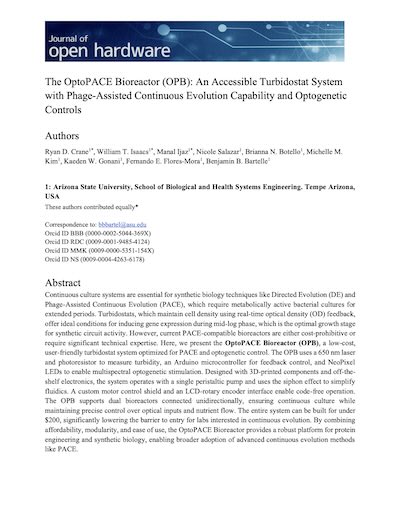
Today's article comes from the Journal of Open Hardware. The authors are Crane et al., from Arizona State University. In this paper, they're showcasing an open-source turbidostat system designed specifically to make PACE accessible to the masses.
Here's a question: how many potential scientific breakthroughs stalled out, not because the hypothesis was wrong, but because the lab couldn't afford the equipment to test it? Certainly more than we'd like to believe. That's one of the reasons why so much research ends up coming out of just a handful of institutions. They've got the budget to do it, and everyone else has to watch from the sidelines.
This is true in particle physics, in genomics, and in large-scale medical trials. And it's also true in synthetic biology, particularly for a technique called PACE: Phage-Assisted Continuous Evolution. You see, PACE is a promising technique for a number of disciplines. It's being used by protein engineers to evolve new enzymes, and by synthetic biologists to tune genetic circuits. It's helping researchers redesign molecular interactions and allowing labs to rapidly test thousands of genetic variants that would normally take years to study.
But all of those types of experiments are quite expensive. And lab-grade PACE equipment can easily run tens of thousands of dollars, if not hundreds of thousands. And in a world where research budgets are getting defunded and entire programs are getting cut, few of the smaller laboratories can afford it.
That's where today's paper comes in. The authors are showcasing an invention called the OptoPACE Bioreactor (OPB). It's an open-source turbidostat system designed specifically to make PACE accessible to the masses. It can do most of the things that any other PACE equipment could do, and it costs under 200 bucks to get up and running. On today's episode, we'll start by covering what PACE is and why the hardware to run it has historically been such a barrier. Then we'll look at how this new system's fluidics, electronics, and optogenetic controls were designed, and how the team validated the machine's performance. Let's dive in.
First, some background. Proteins fold into complex, intricate 3D shapes. And the final shape determines the protein's function. But the shapes that exist in nature aren't always what we want. Sometimes we need a shape that has never existed before. Maybe it's an enzyme that works at a higher temperature than the natural version. Maybe it's an antibody that binds to a target with better precision. Whatever the case, the naturally-occurring proteins just won't do. The issue is, we can't just sit down and build a new protein from scratch. We don't have the tools for that. Instead, we need to borrow a trick from nature: evolution.
Directed Evolution (DE) is a process where you apply selection pressure to a large population of protein variants and then pick the ones that are moving in the direction you want. Traditionally, this happens in discrete cycles. You create a library of variants, test them in plates or flasks, select the best performers, mutate them again, and repeat the process. It's natural selection, done in a lab, and compressed into a timeline we can actually work with. You're essentially fast-forwarding hundreds, or thousands or millions of years of evolution into a matter of weeks. Pretty cool.
PACE takes this idea and removes the stop-and-start cycles. Instead of evolving proteins in batches and manually transferring cultures from one round of experiments to the next, the entire evolutionary process runs continuously inside a bioreactor using bacteriophages.
To run PACE you actually need two bioreactors connected in sequence. The first one, called the turbidostat, grows a continuous supply of bacteria in a metabolically active state. That bacterial culture flows into the second vessel, called the lagoon, where the phages live and evolve. The lagoon is the arena where evolution actually happens. The turbidostat is the machine that keeps the arena running.
The turbidostat is the tricky part. It can't just grow bacteria and hope for the best. It needs to hold the bacterial culture at a very specific growth stage, called mid-log phase, which is the point in the growth cycle where the cells are dividing actively and the gene expression from its synthetic circuits is most reliable. To do this, the turbidostat constantly monitors the density of the culture. When the culture gets too dense, it dilutes it by pumping in fresh media. This process requires real-time feedback, automation, and sensors. Ie: a sophisticated and expensive piece of hardware. And that's what these authors are trying to build, for cheap.
Their first challenge was figuring out how to measure culture density in real time. The way the OPB (their invention) does this is fairly simple: it shines a laser through the culture and measures how much light makes it to the other side. You see, as bacteria grow and multiply, the culture becomes cloudier. The cloudier it is, the less light passes through. A sensor on the far side of the vessel reads that light level continuously, and that reading becomes the proxy for density. Over time, you end up with a curve that tracks the full arc of bacterial growth: exponential growth and (importantly) mid-log phase, all readable and identifiable from a single light sensor.
The whole system is controlled by an Arduino. It acts as the brain: it reads the light sensor, decides whether to turn the pump on or off, controls the LEDs, keeps the stir motors running, and manages the user interface. All of the electronics are mounted on a custom circuit board that plugs directly onto the microcontroller, keeping the entire system compact enough to sit in a small 3D-printed housing on a lab bench.
Flow between the two vessels (the turbidostat and the lagoon) is handled using a basic siphon effect. Remember, you're trying to move liquid continuously from a media reservoir, through the turbidostat, through the lagoon, and out to waste. You could put a pump at every stage, but you don't actually need to. Instead you can just seal the entire system except for one inlet and one outlet, and put a single pump at the very end. That pump pulling liquid out of the lagoon creates negative pressure that propagates backward through the whole system, drawing liquid forward from wherever it currently sits. Gravity handles the drop from the media reservoir (since it's elevated), and negative pressure handles everything after that.
The two culture vessels themselves are pretty straightforward. Each one is a cylinder with two glass pipettes poking through the cap. One pipette is short and sits near the top, and serves as the inlet for liquid. The other is longer, reaches deeper into the vessel, and functions as an overflow drain. Once the liquid level rises to the tip of that pipette, it gets pulled out. This is how the volume in each vessel stays constant, passively, with no sensors and no logic. Both vessels are stirred continuously using small motors that spin magnetic stir bars at the bottom. This keeps the culture well-mixed and the bacteria evenly suspended.
In the lagoon, a ring of programmable LEDs allows researchers to switch gene expression on or off using light. You see, certain proteins are sensitive to specific wavelengths of light. If you engineer a bacterium to express one of these proteins alongside whatever gene you want to control, then you can use light as a switch. Shine a certain color, the gene turns on. Shine a different color, it turns off. In a traditional bioreactor you'd control gene expression by pumping in a chemical inducer. Here, you just change the color of the light.
The OPB has an LCD screen and a rotary encoder, which is essentially a dial with a clickable button, mounted on the front of the housing. Turning the dial scrolls through menu options. Clicking it selects one. With this interface, a user can start a PACE experiment, run a calibration to read out a growth curve, set the LED color for optogenetic stimulation, run a cleaning cycle with bleach solution, or stop an experiment that's in progress. No laptop required after initial calibration. If you want to extend it, the menus are customizable (which requires coding), but the base system is fully operable without touching the codebase.
So that's the setup in a nutshell. To figure out if it worked, the authors ran a series of calibration and validation experiments on it. First, they measured how reliably the turbidity sensor could track bacterial growth over time. As the culture became denser, the photoresistor registered the expected change, and the system produced a growth curve that followed the typical trajectory of bacterial populations. Once they identified the mid-log phase of growth, they set that value as the control point for the turbidostat. From there, the system took over. It automatically activated the pump whenever the culture density drifted above the target, diluted the culture with fresh media and brought the reading back down. And then the reactor maintained that set point with less than about 1% deviation, indicating that the feedback loop between the sensor and the pump was stable enough to keep the bacterial population in a steady growth state.
So overall, it seems that this system works. The next step is for small labs and citizen-scientists to try to build it themselves. If you're interested in doing so, download the full PDF. It includes the bill of materials, the circuit schematics, and the assembly instructions you need to reproduce everything they built. They also provide the 3D-print files, hardware documentation, and the codebase for the Arduino.